Stage Rallying
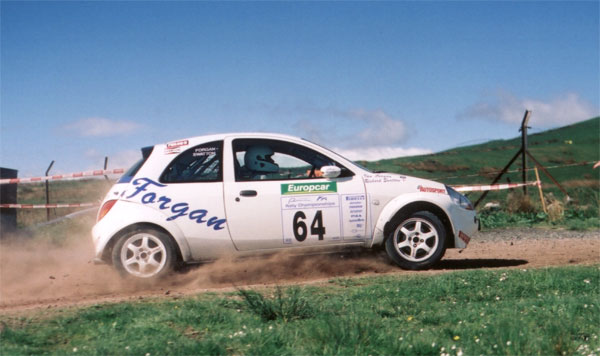
Stage Rallies are won or lost by outright speed on the special stages, roads closed to all other traffic, where cars are timed to the second or tenth of a second.
Stage events are many times more expensive than navigational road rallies. Entry fees are hundreds rather than tens of pounds, tyres last one or two events if you are lucky, fuel consumption is horrendous and many cars are very sensitive to the quality of fuel, so are run on petrol bought from specialist suppliers at the event. Yes it is perfectly ordinary standard road fuel sir, but special perfectly ordinary standard road fuel, and priced accordingly.
Most cars are towed to and from the rallies on trailers, and need a service crew to change tyres, refuel, and do quick repairs between stages, so you need more vehicles and more accomodation. And the cars break, or hit things, and need constant maintenance between events.
You can keep the costs down by running a lower priced and lower powered car, like the 1300 Ka in the picture above, which uses less fuel and doesn't have enough power to destroy a set of tyres every other stage, but whether you spend a quarter of a million on an ex-works world rally championship car, or £400 on a write-off from a salvage auction, the entry fees and the hotel rooms still cost the same.
How much do you want to spend? Sorry, you'll need a lot more than that. Worth every penny, though.
Stage Rallies can be divided into:
Single Venue rallies, where the entire route is on private land, like a race track or airfield, and cars need not be taxed and insured for the public highway, although an MOT is still required;
and
Multi Venue rallies, where the special stages are linked by stretches of public road where the required average speed is low (usually 30mph or slower). Cars must be taxed and insured.
In Scotland, the special stages are usually gravel forest roads, though there are two rallies, the Jim Clark Memorial Rally around Duns, and the Tour of Mull, which were enabled by Acts of Parliament to close stretches of public road to other traffic so that they might be used as special stages.
Through the Langton ford, 100 up hill, handbrake hairpin left on wet tar, power on and gone. Gwyndaff Evans master class on the Jim Clark Memorial Rally.
Stage Rally Championships
The Scottish Rally Championship
A lot of classic forest rallies like the Snowman, Border Counties, Scottish, plus the Jim Clark Reivers on closed tarmac roads. Top of the tree for prestige, and for costs.
The Scottish Tarmack Rally Championship
A mixture of comparatively laid-back single venue rallies on airfields and showground, demanding multi venue events over military training ranges at Otterburn, Warcop and Dundrennan, and the Jim Clark Reivers and the Mull Rally.

The Junior 1000 Ecosse Challenge is aimed at 14-17 year olds and is designed to introduce them to rallying in a safe and controlled manner.
The Championship is held over a series of single venue Junior stage rallies. The basic rules are:
Drivers must be between 14 and 17 years old and at least 1.4m tall.
Drivers must complete a structured training programme before they will be granted a competition licence. This includes passing a Junior BARS test.
Cars have to be standard, non-turbo 1000cc models from any manufacturer with mandatory safety
modifications. No tuning is allowed.
Co-drivers must be over 21 years of age and meet the qualifications of a Motorsport UK RS National Stage Rally licence. They must also be registered in the Scottish PVG scheme.
Many Championship alumni have gone on to drive in the Scottish Rally Championship and the Scottish Tarmack Rally Championship.
For more information, please see the Junior 1000 Ecosse Challenge website www.j1000ecossechallenge.co.uk

The Borders Rally Championship
Four forest rallies, and four on tarmac including the Jim Clark and Otterburn military ranges.


Funny how you never finish building the car till the night before the rally. Here is Gordon Milne's Corsa nearly finished on Mull.
And a couple of years later, here is Gordon's Audi TT nearly finished on Mull, in a blurry phone pic because everybody was far too busy to get a real camera out.
Just a couple of minor adjustments to do, like converting it to permanent four wheel drive with some new bits made by the Rintoul boys. Meanwhile, I am in the cottage assembling the lamp pod and Alan is making the wiring harness. Of course it will be ready in time; No problem, Tony.
All photos © Lock Horsburgh